How to Teach Kids Consent Before They Can Even Spell It | Tough Topics Mom
Jul 22, 2026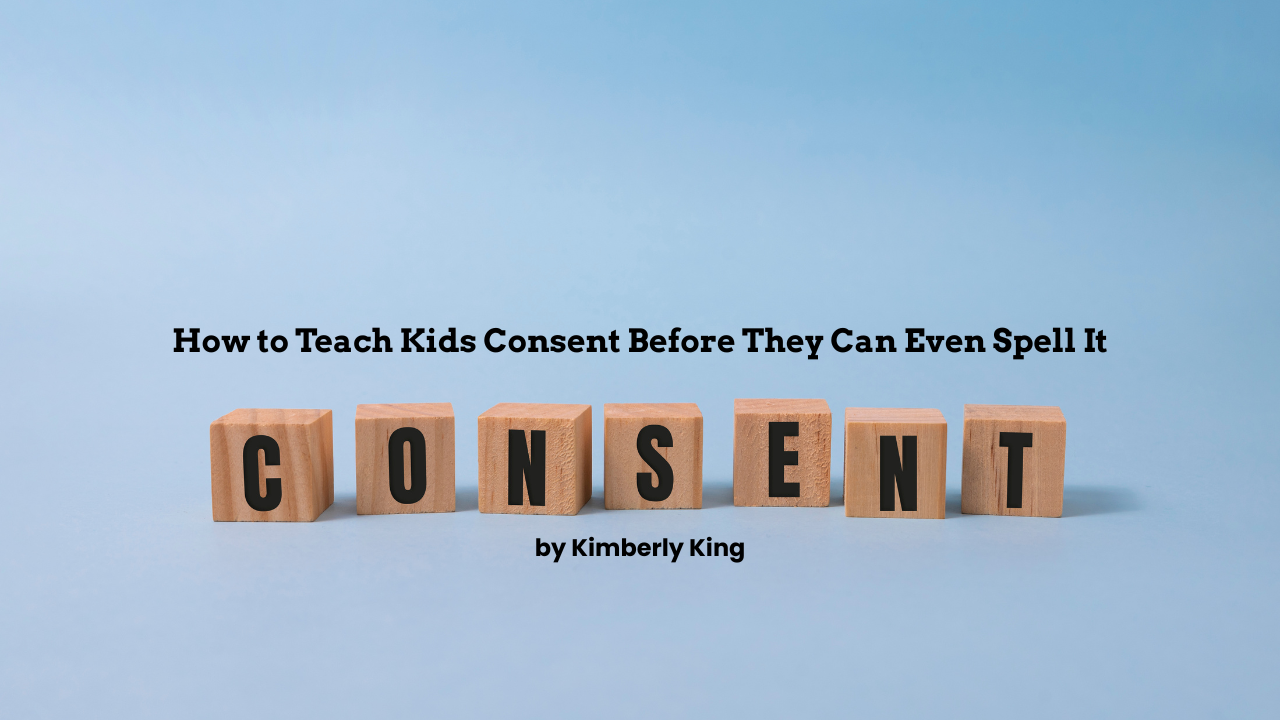
Teaching Kids Consent Starts Before They Can Even Spell the Word Consent
By Kimberly King, M.S.Ed. — Tough Topics Mom®
What if the most important conversation in abuse prevention doesn't start with "the big talk" at all?
What if it starts during a tickle fight?
What if it starts when your kids are being mean to each other?
For nearly twenty years, I've taught children body safety through my books, classrooms, and presentations. Most of that education focuses on one side of the equation: "Your body belongs to you." "Say no." "Tell a trusted adult." "Listen to your gut." These lessons save lives, and I will never stop teaching them.
But lately I've been asking a harder question: what if we've left out half of the conversation?
We've spent decades teaching children, especially girls, how to protect themselves. What if we spent just as much intentional energy teaching children, especially boys... how to protect the boundaries of others?
We've focused on raising empowered potential victims.
What if we focused equally on raising respectful future protectors?
Every Child Needs Body Safety Education
Before anyone misreads this: girls absolutely need body safety education too. Every child, regardless of gender, deserves to know they own their body, that they're allowed to say no, and that they can go to a trusted adult when something doesn't feel right.
But prevention can't stop at empowering the child who might one day need to say no. It also has to raise the child who hears "no" and stops.
Consent Education Doesn't Start in Health Class. It Starts on the Living Room Floor.
The first real-world consent lesson most kids get doesn't happen in a classroom. It happens during a tickle fight.
A little brother keeps tickling after his sister yells, "Stop!" Dad laughs. Mom says, "Oh, he's just playing."
Maybe. Or maybe this is one of the first chances we get to teach one of life's most important lessons:
When someone says stop, we stop. Immediately. No debate. No convincing. No "just one more." No laughing it off.
If the roughhousing keeps going and there's no consequence, here's what kids actually learn in that moment: that "no" and "stop" carry no real weight. Many parents associate consent education with sex. These lessons have nothing to do with sex. It has everything to do with respect and consequences, and it's being taught (or not) in ordinary rooms, every day, whether we mean to teach it or not.
Everyday Moments Are Prevention Opportunities
Prevention doesn't only live in formal lessons. It lives in the small, easy-to-dismiss moments:
- A child grabs a toy from a sibling
- A child opens the bathroom door without knocking
- A child reads someone else's journal
- A child refuses to give back a toy
- A child teases someone who's clearly stopped laughing
- A child keeps wrestling after the other child has had enough
These aren't just parenting headaches. They're teachable moments for empathy, boundaries, and the idea that other people's bodies, space, belongings, and feelings deserve respect. That is prevention.
What Consent Language Sounds Like at Home
Imagine if respect got talked about every week — not as one awkward "sex talk," but as hundreds of small, ordinary conversations:
- "We ask before we hug."
- "We stop when someone says stop."
- "We don't pressure people."
- "We don't manipulate people."
- "We don't use our size or strength to get our way."
- "We apologize-and then we change our behavior."
- "We protect people who are younger than us."
These small conversations are what shape the teenagers and adults our children become. We teach reading every single day. We practice kindness. We coach sports for hours a week. Why do we assume respect for boundaries will just develop on its own? It won't. Children learn what we intentionally teach...and what we consistently model.
I talk about this quite a bit in my book for adults, Body Safety for Young Children: Empowering Caring Adults.
There is actually a free chapter on Amazon right this very moment. Click HERE to check that out.
This isn't about raising fearful boys. It's about raising confident boys who know how to make other people feel safe, and who understand that real strength means self-control. You can tell a lot about a boy by how he treats his sister, brother, and mom.
Think About This Week
Before we get into a step-by-step family plan, sit with these questions for a minute:
- What have you heard come out of your kids' mouths this week?
- Are your kids constantly pushing, shoving, wrestling, or bothering each other?
- Is there verbal or physical roughness that gets brushed off as "just kids"?
- Do you have a discipline plan? Do you have family rules, and do you actually enforce them?
- What do you do when one child tells on another?
If your child negotiates like a tiny lawyer every time you set a boundary, you are not alone. I've been there too—the good news: those moments are exactly where consent-based language gets built...or lost.
A Simple Family Plan for Teaching Consent and Respect
As a kindergarten teacher and a mom, I learned quickly that kids thrive on expectations that are clear, consistent, and stated positively. Give an inch, and lovingly, most kids will take a mile. Getting that inch back is the hard part.
Model what to do, not just what not to do:
| Instead of... | Try... |
|---|---|
| "No hitting." | "Keep your hands and feet to yourself." |
| "No yelling." | "Use an inside voice." |
| "No mean words." | "Use kind words." |
| "Don't grab." | "Ask first." |
Keep family rules simple, positive, and kid-drafted. For example:
- We keep our hands and feet to ourselves.
- We listen when someone says "No" or "Stop."
- We use kind words.
- We ask before touching another person's body or belongings.
- We help make things right when we make a mistake.
When kids make mistakes (and they will):
- Stop the behavior calmly.
- Help your child understand how their actions affected someone else.
- Practice the right behavior together.
- Repair the relationship with a sincere apology or act of kindness.
- Follow through with a fair, age-appropriate consequence when needed.
Consequences should teach, not shame. The goal is accountability and understanding — not punishment for its own sake.
Catch Your Child Being Respectful
Kids are constantly looking to the adults they love for one answer: "Did you notice? Am I doing a good job?" Specific praise answers that question with a confident yes and teaches kids exactly which behaviors to repeat.
Try:
- "I noticed you stopped the first time your sister said 'stop.'"
- "Thank you for asking before giving Grandpa a hug."
- "I saw how kindly you spoke to your cousin."
- "I loved how you listened the first time. That was respectful."
Give kids practice with consent-based language, too:
- "Can I have a hug?"
- "Would you like a hug or a high five?"
- "Do you need help zipping your jacket, or would you like to try first?"
- "Do you need help with the bath, or should I stand by the door and chat with you?"
This is where consent education actually starts — and it grows every time the adults in the house model it with each other, not just with the kids.
Two Classroom Tricks That Actually Work
The marble jar. Every time a child in my classroom showed kindness, listened well, solved a problem peacefully, or respected someone's boundary, they earned a marble.
"I love the way Scarlette shared her markers! That was so kind."
Full jar, pizza party.
The kindness chain. (This doubles beautifully as a consent chain.) When a student does something kind, we stop and name it out loud: "Cole, I love the way you helped Evie pick up her crayons. That was so kind." At lunch, we write down that day's acts of kindness and add a link to the chain. By the end of the year, we've built over 1,000 links and had a great math lesson in the process, estimating and counting by tens along the way. Kids take a piece home, and more than one family has told me they started their own chain at the kitchen table.
All you need: construction paper, scissors, a stapler, and a habit of noticing out loud.
The Goal Isn't Just Kids Who Say No
Our goal isn't only to raise children who know how to say "no." It's to raise children who know how to listen when someone else says it.
Prevention doesn't begin in middle school, in a health class, or with dating. It begins at home on the playground, between siblings, cousins, classmates, and teammates. It begins the first time someone says "stop," and another child chooses to listen.
Frequently Asked Questions
At what age should I start teaching my child about consent? Consent education can start as early as ages 3–5, through everyday moments like tickling, sharing toys, and asking before hugging long before any formal conversation about bodies or safety.
Is teaching consent to toddlers the same as "the talk"? No. Early consent education is about respecting "no" and "stop" in everyday play, listening skills, and boundaries, not about sex. It lays the foundation for body safety conversations that come later.
How do I teach my son to respect boundaries without making him afraid of physical play? Roughhousing and physical play are healthy. The goal isn't to stop play; it's to teach that play stops the moment someone says "stop," every time, without negotiation.
What's the difference between body safety education and consent education? Body safety education traditionally teaches children how to protect themselves (say no, move away, tell a trusted adult). Consent education adds the other half: teaching children to recognize and respect someone else's "no."
Suggested Internal Links
- I Said No! a kid-to-kid guide to consent.
- "Body Safety for Young Children: Empowering Caring Adults" to its Gryphon House
- Link to Raising Safe Siblings course
If this resonated, my book Body Safety for Young Children: Empowering Caring Adults goes deeper into these everyday consent moments,
Click HERE.
And if you're raising more than one child under one roof, Raising Safe Siblings was built exactly for this conversation.
Ready to keep your kids safer this summer? Sign up for the Raising Safe Siblings Class, Body Safety for Summer Camp Bundle, or email me for a parent consultation.
Stay connected with news and updates!
Join our mailing list to receive the latest news and updates from our team.
Don't worry, your information will not be shared.
We hate SPAM. We will never sell your information, for any reason.